Screen fill pygame что это
A pygame Surface is used to represent any image. The Surface has a fixed resolution and pixel format. Surfaces with 8-bit pixels use a color palette to map to 24-bit color.
Call pygame.Surface() pygame object for representing images to create a new image object. The Surface will be cleared to all black. The only required arguments are the sizes. With no additional arguments, the Surface will be created in a format that best matches the display Surface.
The pixel format can be controlled by passing the bit depth or an existing Surface. The flags argument is a bitmask of additional features for the surface. You can pass any combination of these flags:
Both flags are only a request, and may not be possible for all displays and formats.
Advance users can combine a set of bitmasks with a depth value. The masks are a set of 4 integers representing which bits in a pixel will represent each color. Normal Surfaces should not require the masks argument.
Surfaces can have many extra attributes like alpha planes, colorkeys, source rectangle clipping. These functions mainly effect how the Surface is blitted to other Surfaces. The blit routines will attempt to use hardware acceleration when possible, otherwise they will use highly optimized software blitting methods.
There are three types of transparency supported in pygame: colorkeys, surface alphas, and pixel alphas. Surface alphas can be mixed with colorkeys, but an image with per pixel alphas cannot use the other modes. Colorkey transparency makes a single color value transparent. Any pixels matching the colorkey will not be drawn. The surface alpha value is a single value that changes the transparency for the entire image. A surface alpha of 255 is opaque, and a value of 0 is completely transparent.
Per pixel alphas are different because they store a transparency value for every pixel. This allows for the most precise transparency effects, but it also the slowest. Per pixel alphas cannot be mixed with surface alpha and colorkeys.
Any functions that directly access a surface’s pixel data will need that surface to be lock()’ed. These functions can lock() and unlock() the surfaces themselves without assistance. But, if a function will be called many times, there will be a lot of overhead for multiple locking and unlocking of the surface. It is best to lock the surface manually before making the function call many times, and then unlocking when you are finished. All functions that need a locked surface will say so in their docs. Remember to leave the Surface locked only while necessary.
Surface pixels are stored internally as a single number that has all the colors encoded into it. Use the map_rgb() and unmap_rgb() to convert between individual red, green, and blue values into a packed integer for that Surface.
Surfaces can also reference sections of other Surfaces. These are created with the subsurface() method. Any change to either Surface will effect the other.
Each Surface contains a clipping area. By default the clip area covers the entire Surface. If it is changed, all drawing operations will only effect the smaller area.
Draws a source Surface onto this Surface. The draw can be positioned with the dest argument. The dest argument can either be a pair of coordinates representing the position of the upper left corner of the blit or a Rect, where the upper left corner of the rectangle will be used as the position for the blit. The size of the destination rectangle does not effect the blit.
An optional area rectangle can be passed as well. This represents a smaller portion of the source Surface to draw.
New in pygame 1.9.2: Optional special_flags : BLEND_PREMULTIPLIED
The return rectangle is the area of the affected pixels, excluding any pixels outside the destination Surface, or outside the clipping area.
Pixel alphas will be ignored when blitting to an 8 bit Surface.
For a surface with colorkey or blanket alpha, a blit to self may give slightly different colors than a non self-blit.
Creates a new copy of the Surface with the pixel format changed. The new pixel format can be determined from another existing Surface. Otherwise depth, flags, and masks arguments can be used, similar to the pygame.Surface() pygame object for representing images call.
If no arguments are passed the new Surface will have the same pixel format as the display Surface. This is always the fastest format for blitting. It is a good idea to convert all Surfaces before they are blitted many times.
The converted Surface will have no pixel alphas. They will be stripped if the original had them. See convert_alpha() for preserving or creating per-pixel alphas.
The new copy will have the same class as the copied surface. This lets as Surface subclass inherit this method without the need to override, unless subclass specific instance attributes also need copying.
Creates a new copy of the surface with the desired pixel format. The new surface will be in a format suited for quick blitting to the given format with per pixel alpha. If no surface is given, the new surface will be optimized for blitting to the current display.
Unlike the convert() method, the pixel format for the new image will not be exactly the same as the requested source, but it will be optimized for fast alpha blitting to the destination.
As with convert() the returned surface has the same class as the converted surface.
Fill the Surface with a solid color. If no rect argument is given the entire Surface will be filled. The rect argument will limit the fill to a specific area. The fill will also be contained by the Surface clip area.
This will return the affected Surface area.
Move the image by dx pixels right and dy pixels down. dx and dy may be negative for left and up scrolls respectively. Areas of the surface that are not overwritten retain their original pixel values. Scrolling is contained by the Surface clip area. It is safe to have dx and dy values that exceed the surface size.
Set the current color key for the Surface. When blitting this Surface onto a destination, any pixels that have the same color as the colorkey will be transparent. The color can be an RGB color or a mapped color integer. If None is passed, the colorkey will be unset.
The colorkey will be ignored if the Surface is formatted to use per pixel alpha values. The colorkey can be mixed with the full Surface alpha value.
The optional flags argument can be set to pygame.RLEACCEL to provide better performance on non accelerated displays. An RLEACCEL Surface will be slower to modify, but quicker to blit as a source.
Return the current colorkey value for the Surface. If the colorkey is not set then None is returned.
Set the current alpha value for the Surface. When blitting this Surface onto a destination, the pixels will be drawn slightly transparent. The alpha value is an integer from 0 to 255, 0 is fully transparent and 255 is fully opaque. If None is passed for the alpha value, then alpha blending will be disabled, including per-pixel alpha.
This value is different than the per pixel Surface alpha. For a surface with per pixel alpha, blanket alpha is ignored and None is returned.
Changed in pygame 2.0: per-surface alpha can be combined with per-pixel alpha.
The optional flags argument can be set to pygame.RLEACCEL to provide better performance on non accelerated displays. An RLEACCEL Surface will be slower to modify, but quicker to blit as a source.
Return the current alpha value for the Surface.
Lock the pixel data of a Surface for access. On accelerated Surfaces, the pixel data may be stored in volatile video memory or nonlinear compressed forms. When a Surface is locked the pixel memory becomes available to access by regular software. Code that reads or writes pixel values will need the Surface to be locked.
Surfaces should not remain locked for more than necessary. A locked Surface can often not be displayed or managed by pygame.
Not all Surfaces require locking. The mustlock() method can determine if it is actually required. There is no performance penalty for locking and unlocking a Surface that does not need it.
All pygame functions will automatically lock and unlock the Surface data as needed. If a section of code is going to make calls that will repeatedly lock and unlock the Surface many times, it can be helpful to wrap the block inside a lock and unlock pair.
It is safe to nest locking and unlocking calls. The surface will only be unlocked after the final lock is released.
Unlock the Surface pixel data after it has been locked. The unlocked Surface can once again be drawn and managed by pygame. See the lock() documentation for more details.
All pygame functions will automatically lock and unlock the Surface data as needed. If a section of code is going to make calls that will repeatedly lock and unlock the Surface many times, it can be helpful to wrap the block inside a lock and unlock pair.
It is safe to nest locking and unlocking calls. The surface will only be unlocked after the final lock is released.
Returns True if the Surface is required to be locked to access pixel data. Usually pure software Surfaces do not require locking. This method is rarely needed, since it is safe and quickest to just lock all Surfaces as needed.
All pygame functions will automatically lock and unlock the Surface data as needed. If a section of code is going to make calls that will repeatedly lock and unlock the Surface many times, it can be helpful to wrap the block inside a lock and unlock pair.
Returns True when the Surface is locked. It doesn’t matter how many times the Surface is locked.
Returns the currently existing locks for the Surface.
Return a copy of the RGBA Color value at the given pixel. If the Surface has no per pixel alpha, then the alpha value will always be 255 (opaque). If the pixel position is outside the area of the Surface an IndexError exception will be raised.
This function will temporarily lock and unlock the Surface as needed.
New in pygame 1.9: Returning a Color instead of tuple. Use tuple(surf.get_at((x,y))) if you want a tuple, and not a Color. This should only matter if you want to use the color as a key in a dict.
Set the RGBA or mapped integer color value for a single pixel. If the Surface does not have per pixel alphas, the alpha value is ignored. Setting pixels outside the Surface area or outside the Surface clipping will have no effect.
Getting and setting pixels one at a time is generally too slow to be used in a game or realtime situation.
This function will temporarily lock and unlock the Surface as needed.
Return the integer value of the given pixel. If the pixel position is outside the area of the Surface an IndexError exception will be raised.
This method is intended for pygame unit testing. It unlikely has any use in an application.
This function will temporarily lock and unlock the Surface as needed.
Return a list of up to 256 color elements that represent the indexed colors used in an 8-bit Surface. The returned list is a copy of the palette, and changes will have no effect on the Surface.
Returning a list of Color(with length 3) instances instead of tuples.
Returns the red, green, and blue color values for a single index in a Surface palette. The index should be a value from 0 to 255.
New in pygame 1.9: Returning Color(with length 3) instance instead of a tuple.
Set the full palette for an 8-bit Surface. This will replace the colors in the existing palette. A partial palette can be passed and only the first colors in the original palette will be changed.
This function has no effect on a Surface with more than 8-bits per pixel.
Set the palette value for a single entry in a Surface palette. The index should be a value from 0 to 255.
This function has no effect on a Surface with more than 8-bits per pixel.
Convert an RGBA color into the mapped integer value for this Surface. The returned integer will contain no more bits than the bit depth of the Surface. Mapped color values are not often used inside pygame, but can be passed to most functions that require a Surface and a color.
See the Surface object documentation for more information about colors and pixel formats.
Convert an mapped integer color into the RGB color components for this Surface. Mapped color values are not often used inside pygame, but can be passed to most functions that require a Surface and a color.
See the Surface object documentation for more information about colors and pixel formats.
Each Surface has an active clipping area. This is a rectangle that represents the only pixels on the Surface that can be modified. If None is passed for the rectangle the full Surface will be available for changes.
The clipping area is always restricted to the area of the Surface itself. If the clip rectangle is too large it will be shrunk to fit inside the Surface.
Return a rectangle of the current clipping area. The Surface will always return a valid rectangle that will never be outside the bounds of the image. If the Surface has had None set for the clipping area, the Surface will return a rectangle with the full area of the Surface.
Returns a new Surface that shares its pixels with its new parent. The new Surface is considered a child of the original. Modifications to either Surface pixels will effect each other. Surface information like clipping area and color keys are unique to each Surface.
The new Surface will inherit the palette, color key, and alpha settings from its parent.
It is possible to have any number of subsurfaces and subsubsurfaces on the parent. It is also possible to subsurface the display Surface if the display mode is not hardware accelerated.
See get_offset() and get_parent() to learn more about the state of a subsurface.
A subsurface will have the same class as the parent surface.
Returns the parent Surface of a subsurface. If this is not a subsurface then None will be returned.
Returns the parent Surface of a subsurface. If this is not a subsurface then this surface will be returned.
Get the offset position of a child subsurface inside of a parent. If the Surface is not a subsurface this will return (0, 0).
Get the offset position of a child subsurface inside of its top level parent Surface. If the Surface is not a subsurface this will return (0, 0).
Return the width and height of the Surface in pixels.
Return the width of the Surface in pixels.
Return the height of the Surface in pixels.
Returns a new rectangle covering the entire surface. This rectangle will always start at (0, 0) with a width and height the same size as the image.
You can pass keyword argument values to this function. These named values will be applied to the attributes of the Rect before it is returned. An example would be mysurf.get_rect(center=(100, 100)) to create a rectangle for the Surface centered at a given position.
Returns the number of bits used to represent each pixel. This value may not exactly fill the number of bytes used per pixel. For example a 15 bit Surface still requires a full 2 bytes.
Return the number of bytes used per pixel.
Here is a more complete list of flags. A full list can be found in SDL_video.h
Used internally (read-only)
Return the number of bytes separating each row in the Surface. Surfaces in video memory are not always linearly packed. Subsurfaces will also have a larger pitch than their real width.
This value is not needed for normal pygame usage.
Returns the bitmasks used to isolate each color in a mapped integer.
This value is not needed for normal pygame usage.
This is not needed for normal pygame usage.
In SDL2, the masks are read-only and accordingly this method will raise an AttributeError if called.
Returns the pixel shifts need to convert between each color and a mapped integer.
This value is not needed for normal pygame usage.
This is not needed for normal pygame usage.
In SDL2, the shifts are read-only and accordingly this method will raise an AttributeError if called.
Return the least significant number of bits stripped from each color in a mapped integer.
This value is not needed for normal pygame usage.
Returns the smallest rectangular region that contains all the pixels in the surface that have an alpha value greater than or equal to the minimum alpha value.
This function will temporarily lock and unlock the Surface as needed.
Return an object which exports a surface’s internal pixel buffer as a C level array struct, Python level array interface or a C level buffer interface. The pixel buffer is writeable. The new buffer protocol is supported for Python 2.6 and up in CPython. The old buffer protocol is also supported for Python 2.x. The old buffer data is in one segment for kind ‘0’, multi-segment for other buffer view kinds.
The kind argument is the length 1 string ‘0’, ‘1’, ‘2’, ‘3’, ‘r’, ‘g’, ‘b’, or ‘a’. The letters are case insensitive; ‘A’ will work as well. The argument can be either a Unicode or byte (char) string. The default is ‘2’.
‘0’ returns a contiguous unstructured bytes view. No surface shape information is given. A ValueError is raised if the surface’s pixels are discontinuous.
‘1’ returns a (surface-width * surface-height) array of continuous pixels. A ValueError is raised if the surface pixels are discontinuous.
‘2’ returns a (surface-width, surface-height) array of raw pixels. The pixels are surface-bytesize-d unsigned integers. The pixel format is surface specific. The 3 byte unsigned integers of 24 bit surfaces are unlikely accepted by anything other than other pygame functions.
‘3’ returns a (surface-width, surface-height, 3) array of RGB color components. Each of the red, green, and blue components are unsigned bytes. Only 24-bit and 32-bit surfaces are supported. The color components must be in either RGB or BGR order within the pixel.
‘r’ for red, ‘g’ for green, ‘b’ for blue, and ‘a’ for alpha return a (surface-width, surface-height) view of a single color component within a surface: a color plane. Color components are unsigned bytes. Both 24-bit and 32-bit surfaces support ‘r’, ‘g’, and ‘b’. Only 32-bit surfaces with SRCALPHA support ‘a’.
The surface is locked only when an exposed interface is accessed. For new buffer interface accesses, the surface is unlocked once the last buffer view is released. For array interface and old buffer interface accesses, the surface remains locked until the BufferProxy object is released.
Return a buffer object for the pixels of the Surface. The buffer can be used for direct pixel access and manipulation. Surface pixel data is represented as an unstructured block of memory, with a start address and length in bytes. The data need not be contiguous. Any gaps are included in the length, but otherwise ignored.
This method implicitly locks the Surface. The lock will be released when the returned pygame.BufferProxy pygame object to export a surface buffer through an array protocol object is garbage collected.
The starting address of the surface’s raw pixel bytes.
Библиотека Pygame / Часть 1. Введение
Это первая часть серии руководств «Разработка игр с помощью Pygame». Она предназначена для программистов начального и среднего уровней, которые заинтересованы в создании игр и улучшении собственных навыков кодирования на Python.
Код в уроках был написан на Python 3.7 и Pygame 1.9.6
Что такое Pygame?
Pygame — это «игровая библиотека», набор инструментов, помогающих программистам создавать игры. К ним относятся:
Игровой цикл
В сердце каждой игры лежит цикл, который принято называть «игровым циклом». Он запускается снова и снова, делая все, чтобы работала игра. Каждый цикл в игре называется кадром.
В каждом кадре происходит масса вещей, но их можно разбить на три категории:
Речь идет обо всем, что происходит вне игры — тех событиях, на которые она должна реагировать. Это могут быть нажатия клавиш на клавиатуре, клики мышью и так далее.
Изменение всего, что должно измениться в течение одного кадра. Если персонаж в воздухе, гравитация должна потянуть его вниз. Если два объекта встречаются на большой скорости, они должны взорваться.
В этом шаге все выводится на экран: фоны, персонажи, меню. Все, что игрок должен видеть, появляется на экране в нужном месте.
Время
Еще один важный аспект игрового цикла — скорость его работы. Многие наверняка знакомы с термином FPS, который расшифровывается как Frames Per Second (или кадры в секунду). Он указывает на то, сколько раз цикл должен повториться за одну секунду. Это важно, чтобы игра не была слишком медленной или быстрой. Важно и то, чтобы игра не работала с разной скоростью на разных ПК. Если персонажу необходимо 10 секунд на то, чтобы пересечь экран, эти 10 секунд должны быть неизменными для всех компьютеров.
Создание шаблона Pygame
Теперь, зная из каких элементов состоит игра, можно переходить к процессу написания кода. Начать стоит с создания простейшей программы pygame, которая всего лишь открывает окно и запускает игровой цикл. Это отправная точка для любого проекта pygame.
В начале программы нужно импортировать необходимые библиотеки и задать базовые переменные настроек игры:
Дальше необходимо открыть окно игры:
Теперь необходимо создать игровой цикл:
Раздел рендеринга (отрисовки)
Начнем с раздела отрисовки. Персонажей пока нет, поэтому экран можно заполнить сплошным цветом. Чтобы сделать это, нужно разобраться, как компьютер обрабатывает цвета.
Экраны компьютеров сделаны из пикселей, каждый из которых содержит 3 элемента: красный, зеленый и синий. Цвет пикселя определяется тем, как горит каждый из элементов: 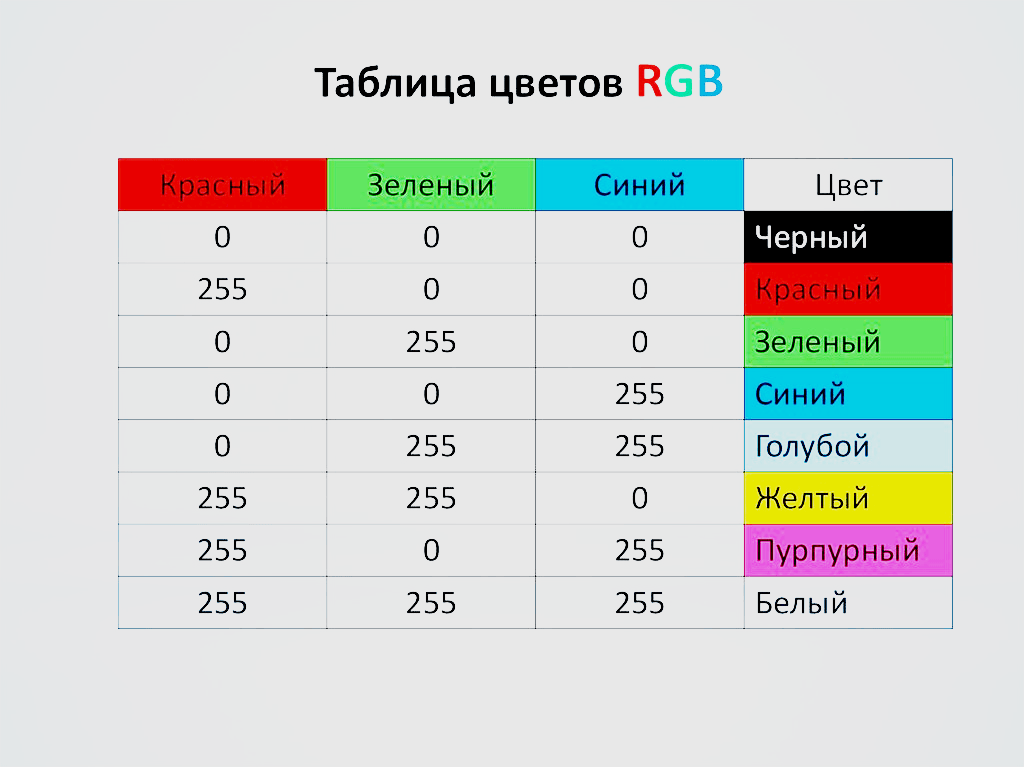
Каждый из трех основных цветов может иметь значение от 0 (выключен) до 255 (включен на 100%), так что для каждого элемента есть 256 вариантов.
Узнать общее количество отображаемых компьютером цветов можно, умножив:
Теперь, зная, как работают цвета, можно задать их в начале программ:
А после этого — заполнить весь экран.
Но этого недостаточно. Дисплей компьютера работает не так. Изменить пиксель — значит передать команду видеокарте, чтобы она передала соответствующую команду экрану. По компьютерным меркам это очень медленный процесс. Если нужно нарисовать на экране много всего, это займет много времени. Исправить это можно оригинальным способом, который называется — двойная буферизация. Звучит необычно, но вот что это такое.
Представьте, что у вас есть двусторонняя доска, которую можно поворачивать, показывая то одну, то вторую сторону. Одна будет дисплеем (то, что видит игрок), а вторая — оставаться скрытой, ее сможет «видеть» только компьютер. С каждым кадром рендеринг будет происходить на задней части доски. Когда отрисовка завершается, доска поворачивается и ее содержимое демонстрируется игроку.
А это значит, что процесс отрисовки происходит один раз за кадр, а не при добавлении каждого элемента.
В pygame это происходит автоматически. Нужно всего лишь сказать доске, чтобы она перевернулась, когда отрисовка завершена. Эта команда называется flip() :
Главное — сделать так, чтобы функция flip() была в конце. Если попытаться отрисовать что-то после поворота, это содержимое не отобразится на экране.
Раздел ввода (событий)
Игры еще нет, поэтому пока сложно сказать, какие кнопки или другие элементы управления понадобятся. Но нужно настроить одно важное событие. Если попытаться запустить программу сейчас, то станет понятно, что нет возможности закрыть окно. Нажать на крестик в верхнем углу недостаточно. Это тоже событие, и необходимо сообщить программе, чтобы она считала его и, соответственно, закрыла игру.
События происходят постоянно. Что, если игрок нажимает кнопку прыжка во время отрисовки? Это нельзя игнорировать, иначе игрок будет разочарован. Для этого pygame сохраняет все события, произошедшие с момента последнего кадра. Даже если игрок будет лупить по кнопкам, вы не пропустите ни одну из них. Создается список, и с помощью цикла for можно пройтись по всем из них.
Контроль FPS
Пока что нечего поместить в раздел Update (обновление), но нужно убедиться, что настройка FPS контролирует скорость игры. Это можно сделать следующим образом:
Команда tick() просит pygame определить, сколько занимает цикл, а затем сделать паузу, чтобы цикл (целый кадр) длился нужно время. Если задать значение FPS 30, это значит, что длина одного кадра — 1/30, то есть 0,03 секунды. Если цикл кода (обновление, рендеринг и прочее) занимает 0,01 секунды, тогда pygame сделает паузу на 0,02 секунды.
Наконец, нужно убедиться, что когда игровой цикл завершается, окно игры закрывается. Для этого нужно поместить функцию pygame.quit() в конце кода. Финальный шаблон pygame будет выглядеть вот так:
В следующем руководстве этот шаблон будет использован как отправная точка для изучения процесса отрисовки объектов на экране и их движения.