Oracle clusterware что это
По Вашему запросу ничего не найдено.
Рекомендуем сделать следующее:
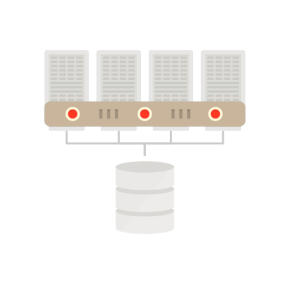
A High Availability Cluster and the Foundation for Oracle RAC
Oracle Clusterware is a portable cluster software that allows clustering of independent servers so that they cooperate as a single system. Oracle Clusterware was first released with Oracle Database 10g Release 1 as the required cluster technology for the Oracle multi-instance database, Oracle Real Application Clusters (RAC).
What’s New in Oracle Clusterware

White Paper: What’s New in Oracle Clusterware (PDF)
Video: Oracle Clusterware Introduction
Video: Autonomous Database Keynote Highlights
Learn more
Architecture
Oracle Clusterware, grouped with Oracle Automatic Storage Management (ASM) as Oracle Grid Infrastructure, is the integrated foundation for Oracle Real Application Clusters and the high availability and resource management framework for all applications on any major platform supported for Oracle RAC. Over the past 10 or more years, Oracle Clusterware 11g and then Oracle Clusterware 12c and Oracle Clusterware 18c provide a high quality platform that enabled high availability and scalability for RAC databases and applications. Now, Oracle Clusterware 19c builds on this innovative technology by further simplifying cluster deployments and improving the overall ease of use. Oracle Clusterware is leveraged in the cloud in order to provide enterprise-class resiliency where required and dynamic as well as online allocation of compute resources where needed, when needed.
New in Oracle Clusterware
Oracle Clusterware 19c continues the purpose of previous releases in simplifying deployments and enhancing the user experience. Primary in these is the removal of Leaf Nodes from the Flex Cluster architecture. Instead, Oracle Clusterware 19c will provide support for read-moslty database instance and application-only cluster nodes on the standard Hub nodes, thus simplifying both the deployment and operational management of the clusters. This will be particularly beneficial in the cases of mixed cluster workloads and consolidated database systems.
With Oracle Cluserware 18c, we introduced significant enhancements and new features that focused primarily on ease of use and the reduction of operating overhead. A primary benefit was the reduction in the number of IP-addresses required for deployments provided by removing the need for Node VIP’s and utilizing a Shared SCAN VIP setup amongst many clusters. Of special note was the addition of the capability to patch the GI stack without affecting the local RAC database instance, thus not impacting the users of that database. Significant enhancements were also made for the Cluster Domains (added in Oracle 12c Release 2), adding the ability to convert Standalone Clusters to Member Clusters and the provisioning of local ACFS file systems on Member Clusters using the remote ASM storage services. In addition is the introduction of Cross-Cluster Dependency Protocol Proxies, enabling Clusterware resource dependency management across clusters.
Oracle Grid Infrastructure (Bundled) Agents
Oracle Grid Infrastructure provides the necessary components to manage high availability (HA) for any business critical application. HA in consolidated environments is no longer simple active/standby failover. These environments require run-time workload management that guarantees resource allocation when required. Oracle Grid Infrastructure Agents enable workload management and HA for Oracle applications (currently available for Siebel, Oracle E-Business Suite, Oracle GoldenGate, Peoplesoft, JD Edwards, WebLogic as well as Apache and MySQL). With Oracle Grid Infrastructure 11g Release 2 (11.2.0.3 and later), the only delivery method for agents was «standalone»; supported on AIX, Solaris, Linux and Windows.
The standalone deployment model offers greater flexibility in choosing the agent home directory structure and for subsequent agent upgrades. The standalone deployment is the preferred installation model and will continue to be available, though support for the bundled agents (those ‘bundled’ with the release of the Grid Infrastructure software) will continue.
Oracle RAC Family of Solutions
The Oracle RAC Family of Solutions refers to the collection of products and features that licensed Oracle RAC or Oracle RAC One Node customers can use free of additional charge. Each solution either enhances or complements the core Oracle RAC offering by ensuring better high availability and scalability or by automating and simplifying day-to-day operation. Learn more about these valuable enhancements by following the link for each solution in the graphic below. To learn more about Oracle Clusterware, follow the link on the bottom of the page.
Oracle RAC. Общее описание / Часть 1
 Высоконагруженные сайты, доступность «5 nines». На заднем фоне (backend) куча обрабатываемой информации в базе данных. А что, если железо забарахлит, если вылетит какая-то давно не проявлявшаяся ошибка в ОС, упадет сетевой интерфейс? Что будет с доступностью информации? Из чистого любопытства я решил рассмотреть, какие решения вышеперечисленным проблемам предлагает Oracle. Последние версии, в отличие от Oracle 9i, называются Oracle 10g (или 11g), где g – означает «grid», распределенные вычисления. В основе распределенных вычислений «как ни крути» лежат кластера, и дополнительные технологии репликации данных (DataGuard, Streams). В этой статье в общих чертах описано, как устроен кластер на базе Oracle 10g. Называется он Real Application Cluster (RAC).
Статья не претендует на полноту и всеобъемлемость, также в ней исключены настройки (дабы не увеличивать в объеме). Смысл – просто дать представление о технологии RAC.
Статью хотелось написать как можно доступнее, чтобы прочесть ее было интересно даже человеку, мало знакомому с СУБД Oracle. Поэтому рискну начать описание с аспектов наиболее часто встречаемой конфигурации БД – single-instance, когда на одном физическом сервере располагается одна база данных (RDBMS) Oracle. Это не имеет непосредственного отношения к кластеру, но основные требования и принципы работы будут одинаковы.
Введение. Single-instance.

Во всех современных реляционных БД данные хранятся в таблицах. Таблицы, индексы и другие объекты в Oracle хранятся в логических контейнерах – табличных пространствах (tablespace). Физически же tablespace располагаются в одном или нескольких файлах на диске. Хранятся они следующим образом:
Каждый объект БД (таблицы, индексы, сегменты отката и.т.п.) хранится в отдельном сегменте – области диска, которая может занимать пространство в одном или нескольких файлах. Сегменты в свою очередь, состоят из одного или нескольких экстентов. Экстент – это непрерывный фрагмента пространства в файле. Экстенты состоят из блоков. Блок – наименьшая единица выделения пространства в Oracle, по умолчанию равная 8K. В блоках хранятся строки данных, индексов или промежуточные результаты блокировок. Именно блоками сервер Oracle обычно выполняет чтение и запись на диск. Блоки имеют адрес, так называемый DBA (Database Block Address).

При любом обращении DML (Data Manipulation Language) к базе данных, Oracle подгружает соответствующие блоки с диска в оперативную память, а именно в буферный кэш. Хотя возможно, что они уже там присутствуют, и тогда к диску обращаться не нужно. Если запрос изменял данные (update, insert, delete), то изменения блоков происходят непосредственно в буферном кэше, и они помечаются как dirty (грязные). Но блоки не сразу сбрасываются на диск. Ведь диск – самое узкое место любой базы данных, поэтому Oracle старается как можно меньше к нему обращаться. Грязные блоки будут сброшены на диск автоматически фоновым процессом DBWn при прохождении контрольной точки (checkpoint) или при переключении журнала.


Когда в базу данных поступает запрос на изменение, то Oracle применяет его в буферном кэше, параллельно внося информацию, достаточную для повторения этого действия, в буфер повторного изменения (redo log buffer), находящийся в оперативной памяти. Как только транзакция завершается, происходит ее подтверждение (commit), и сервер сбрасывает содержимое redo buffer log на диск в redo log в режиме append-write и фиксирует транзакцию. Такой подход гораздо менее затратен, чем запись на диск непосредственно измененного блока. При сбое сервера кэш и все изменения в нем потеряются, но файлы redo log останутся. При включении Oracle начнет с того, что заглянет в них и повторно выполнит изменения таблиц (транзакции), которые не были отражены в datafiles. Это называется «накатить» изменения из redo, roll-forward. Online redo log сбрасывается на диск (LGWR) при подтверждении транзакции, при прохождении checkpoint или каждые 3 секунды (default).
С undo немного посложнее. С каждой таблицей в соседнем сегменте хранится ассоциированный с ней сегмент отмены. При запросе DML вместе с блоками таблицы обязательно подгружаются данные из сегмента отката и хранятся также в буферном кэше. Когда данные в таблице изменяются в кэше, в кэше так же происходит изменение данных undo, туда вносятся «противодействия». То есть, если в таблицу был внесен insert, то в сегмент отката вносится delete, delete – insert, update – вносится предыдущее значение строки. Блоки (и соответствующие данные undo) помечаются как грязные и переходят в redo log buffer. Да-да, в redo журнал записываются не только инструкции, какие изменения стоит внести (redo), но и какие у них противодействия (undo). Так как LGWR сбрасывает redo log buffer каждые 3 секунды, то при неудачном выполнении длительной транзакции (на пару минут), когда после минуты сервер упал, в redo будут записи не завершенные commit. Oracle, как проснется, накатит их (roll-forward), и по восстановленным (из redo log) в памяти сегментам отката данных отменит (roll-back) все незафиксированные транзакции. Справедливость восстановлена.
Кратко стоит упомянуть еще одно неоспоримое преимущество undo сегмента. По второму сценарию (из схемы) когда select дойдет до чтения блока (DBA) 500, он вдруг обнаружит что этот блок в кэше уже был изменен (пометка грязный), и поэтому обратится к сегменту отката, для того чтобы получить соответствующее предыдущее состояние блока. Если такого предыдущего состояния (flashback) в кэше не присутствовало, он прочитает его с диска, и продолжит выполнение select. Таким образом, даже при длительном «select count(money) from bookkeeping» дебет с кредитом сойдется. Согласованно по чтению (CR).
Отвлеклись. Пора искать подступы к кластерной конфигурации. =)
Уровень доступа к данным. ASM.

Хранилищем (datastorage) в больших БД почти всегда выступает SAN (Storage Area Network), который предоставляет прозрачный интерфейс серверам к дисковым массивам.
Сторонние производители (Hitachi, HP, Sun, Veritas) предлагают комплексные решения по организации таких SAN на базе ряда протоколов (самым распространенным является Fibre Channel), с дополнительными функциональными возможностями: зеркалирование, распределение нагрузки, подключение дисков на лету, распределение пространства между разделами и.т.п.
Позиция корпорации Oracle в вопросе построения базы данных любого масштаба сводится к тому, что Вам нужно только соответствующее ПО от Oracle (с соответствующими лицензиями), а выбранное оборудование – по возможности (если средства останутся после покупки Oracle :). Таким образом, для построения высоконагруженной БД можно обойтись без дорогостоящих SPARC серверов и фаршированных SAN, используя сервера на бесплатном Linux и дешевые RAID-массивы.
На уровне доступа к данным и дискам Oracle предлагает свое решение – ASM (Automatic Storage Management). Это отдельно устанавливаемый на каждый узел кластера мини-экземпляр Oracle (INSTANCE_TYPE = ASM), предоставляющий сервисы работы с дисками.
Oracle старается избегать обращений к диску, т.к. это является, пожалуй, основным bottleneck любой БД. Oracle выполняет функции кэширования данных, но ведь и файловые системы так же буферизуют запись на диск. А зачем дважды буферизировать данные? Причем, если Oracle подтвердил транзакцию и получил уведомления том, что изменения в файлы внесены, желательно, чтобы они уже находились там, а не в кэше, на случай «падения» БД. Поэтому рекомендуется использовать RAW devices (диски без файловой системы), что делает ASM.
Таким образом, кластер теперь может хранить и читать данные с общего файлового хранилища.
Пора на уровень повыше.
Clusterware. CRS.
На данном уровне необходимо обеспечить координацию и совместную работу узлов кластера, т.е. clusterware слой: где-то между самим экземпляром базы данных и дисковым хранилищем:
CRS (Cluster-Ready Services) – набор сервисов, обеспечивающий совместную работу узлов, отказоустойчивость, высокую доступность системы, восстановление системы после сбоя. CRS выглядит как «мини-экземпляр» БД (ПО) устанавливаемый на каждый узел кластера. Устанавливать CRS – в обязательном порядке для построения Oracle RAC. Кроме того, CRS можно интегрировать с решениями clusterware от сторонних производителей, таких как HP или Sun.
Опять немного «терминологии»…
Как уже стало ясно из таблички, самым главным процессом, «самым могущественным демоном», является CRSD (Cluster Ready Services Daemon). В его обязанности входит: запуск, остановка узла, генерация failure logs, реконфигурация кластера в случае падения узла, он также отвечает за восстановление после сбоев и поддержку файла профилей OCR. Если демон падает, то узел целиком перезагружается. CRS управляет ресурсами OCR: Global Service Daemon (GSD), ONS Daemon, Virtual Internet Protocol (VIP), listeners, databases, instances, and services.
Информатором в кластере выступает EVMD (Event Manager Daemon), который оповещает узлы о событиях: о том, что узел запущен, потерял связь, восстанавливается. Он выступает связующим звеном между CRSD и CSSD. Оповещения также направляются в ONS (Oracle Notification Services), универсальный шлюз Oracle, через который оповещения можно рассылать, например, в виде SMS или e-mail.
Стартует кластер примерно по следующей схеме: CSSD читает из общего хранилища OCR, откуда считывает кластерную конфигурацию, чтобы опознать, где расположен voting disk, читает voting disk, чтобы узнать сколько узлов (поднялось) в кластере и их имена, устанавливает соединения с соседними узлами по протоколу IPC. Обмениваясь heartbeat, проверяет, все ли соседние узлы поднялись, и выясняет, кто в текущей конфигурации определился как master. Ведущим (master) узлом становится первый запустившийся узел. После старта, все запущенные узлы регистрируются у master, и впоследствии будут предоставлять ему информацию о своих ресурсах.
Уровнем выше CRS на узлах установлены экземпляры базы данных.
Друг с другом узлы общаются по private сети – Cluster Interconnect, по протоколу IPC (Interprocess Communication). К ней предъявляются требования: высокая ширина пропускной способности и малые задержки. Она может строиться на основе высокоскоростных версий Ethernet, решений сторонних поставщиков (HP, Veritas, Sun), или же набирающего популярность InfiniBand. Последний кроме высокой пропускной способности пишет и читает непосредственно из буфера приложения, без необходимости в осуществлении вызовов уровня ядра. Поверх IP Oracle рекомендует использовать UDP для Linux, и TCP для среды Windows. Также при передаче пакетов по interconnect Oracle рекомендует укладываться в рамки 6-15 ms для задержек.
1 Introduction to Oracle Clusterware
This chapter includes the following topics:
What is Oracle Clusterware?
Oracle Clusterware enables servers to communicate with each other, so that they appear to function as a collective unit. This combination of servers is commonly known as a cluster. Although the servers are standalone servers, each server has additional processes that communicate with other servers. In this way the separate servers appear as if they are one system to applications and end users.
Figure 1-1 shows a configuration that uses Oracle Clusterware to extend the basic single-instance Oracle Database architecture. In Figure 1-1, the cluster is running Oracle Database and is actively servicing applications and users. Using Oracle Clusterware, you can use the same high availability mechanisms to make your Oracle database and your custom applications highly available.
Figure 1-1 Oracle Clusterware Configuration

Description of «Figure 1-1 Oracle Clusterware Configuration»
The benefits of using a cluster include:
Scalability of applications
Reduce total cost of ownership for the infrastructure by providing a scalable system with low-cost commodity hardware
Ability to fail over
Increase throughput on demand for cluster-aware applications, by adding servers to a cluster to increase cluster resources
Increase throughput for cluster-aware applications by enabling the applications to run on all of the nodes in a cluster
Ability to program the startup of applications in a planned order that ensures dependent processes are started
Ability to monitor processes and restart them if they stop
Eliminate unplanned downtime due to hardware or software malfunctions
Reduce or eliminate planned downtime for software maintenance
You can program Oracle Clusterware to manage the availability of user applications and Oracle databases. In an Oracle RAC environment, Oracle Clusterware manages all of the resources automatically. All of the applications and processes that Oracle Clusterware manages are either cluster resource s or local resource s.
Oracle Clusterware is required for using Oracle RAC; it is the only clusterware that you need for platforms on which Oracle RAC operates. Although Oracle RAC continues to support many third-party clusterware products on specific platforms, you must also install and use Oracle Clusterware. Note that the servers on which you want to install and run Oracle Clusterware must use the same operating system.
Using Oracle Clusterware eliminates the need for proprietary vendor clusterware and provides the benefit of using only Oracle software. Oracle provides an entire software solution, including everything from disk management with Oracle Automatic Storage Management (Oracle ASM) to data management with Oracle Database and Oracle RAC. In addition, Oracle Database features, such as Oracle Services, provide advanced functionality when used with the underlying Oracle Clusterware high availability framework.
Oracle Clusterware has two stored components, besides the binaries: The voting disk files, which record node membership information, and the Oracle Cluster Registry (OCR), which records cluster configuration information. Voting disks and OCRs must reside on shared storage available to all cluster member nodes.
Understanding System Requirements for Oracle Clusterware
To use Oracle Clusterware, you must understand the hardware and software concepts and requirements as described in the following sections:
Oracle Clusterware Hardware Concepts and Requirements
Many hardware providers have validated cluster configurations that provide a single part number for a cluster. If you are new to clustering, then use the information in this section to simplify your hardware procurement efforts when you purchase hardware to create a cluster.
A cluster consists of one or more servers. The hardware in a server in a cluster (or cluster member or node) is similar to a standalone server. However, a server that is part of a cluster, otherwise known as a node or a cluster member, requires a second network. This second network is referred to as the interconnect. For this reason, cluster member nodes require at least two network interface cards: one for a public network and one for a private network. The interconnect network is a private network using a switch (or multiple switches) that only the nodes in the cluster can access. Foot 1
Oracle does not support using crossover cables as Oracle Clusterware interconnects.
Cluster size is determined by the requirements of the workload running on the cluster and the number of nodes that you have configured in the cluster. If you are implementing a cluster for high availability, then configure redundancy for all of the components of the infrastructure as follows:
At least two network interfaces for the public network, bonded to provide one address
At least two network interfaces for the private interconnect network
The cluster requires cluster-aware storage Foot 2 that is connected to each server in the cluster. This may also be referred to as a multihost device. Oracle Clusterware supports NFS, iSCSI, Direct Attached Storage (DAS), Storage Area Network (SAN) storage, and Network Attached Storage (NAS).
To provide redundancy for storage, generally provide at least two connections from each server to the cluster-aware storage. There may be more connections depending on your I/O requirements. It is important to consider the I/O requirements of the entire cluster when choosing your storage subsystem.
Most servers have at least one local disk that is internal to the server. Often, this disk is used for the operating system binaries; you can also use this disk for the Oracle software binaries. The benefit of each server having its own copy of the Oracle binaries is that it increases high availability, so that corruption to a one binary does not affect all of the nodes in the cluster simultaneously. It also allows rolling upgrades, which reduce downtime.
Oracle Clusterware Operating System Concepts and Requirements
Each server must have an operating system that is certified with the Oracle Clusterware version you are installing. Refer to the certification matrices available in the Oracle Grid Infrastructure Installation Guide for your platform or on My Oracle Support (formerly Oracle MetaLink ) for details, which are available from the following URL:
When the operating system is installed and working, you can then install Oracle Clusterware to create the cluster. Oracle Clusterware is installed independently of Oracle Database. Once Oracle Clusterware is installed, you can then install Oracle Database or Oracle RAC on any of the nodes in the cluster.
Your platform-specific Oracle database installation documentation
Oracle Clusterware Software Concepts and Requirements
Oracle Clusterware uses voting disk files to provide fencing and cluster node membership determination. OCR provides cluster configuration information. You can place the Oracle Clusterware files on either Oracle ASM or on shared common disk storage. If you configure Oracle Clusterware on storage that does not provide file redundancy, then Oracle recommends that you configure multiple locations for OCR and voting disks. The voting disks and OCR are described as follows:
Oracle Clusterware uses voting disk files to determine which nodes are members of a cluster. You can configure voting disks on Oracle ASM, or you can configure voting disks on shared storage.
If you configure voting disks on Oracle ASM, then you do not need to manually configure the voting disks. Depending on the redundancy of your disk group, an appropriate number of voting disks are created.
You should have at least three voting disks, unless you have a storage device, such as a disk array that provides external redundancy. Oracle recommends that you do not use more than five voting disks. The maximum number of voting disks that is supported is 15.
Oracle Cluster Registry
Oracle Clusterware uses the Oracle Cluster Registry (OCR) to store and manage information about the components that Oracle Clusterware controls, such as Oracle RAC databases, listeners, virtual IP addresses (VIPs), and services and any applications. OCR stores configuration information in a series of key-value pairs in a tree structure. To ensure cluster high availability, Oracle recommends that you define multiple OCR locations. In addition:
You can have up to five OCR locations
Each OCR location must reside on shared storage that is accessible by all of the nodes in the cluster
You can replace a failed OCR location online if it is not the only OCR location
Chapter 2, «Administering Oracle Clusterware» for more information about voting disks and OCR
Oracle Clusterware Network Configuration Concepts
Oracle Clusterware enables a dynamic Grid Infrastructure through the self-management of the network requirements for the cluster. Oracle Clusterware 11 g release 2 (11.2) supports the use of dynamic host configuration protocol (DHCP) for the VIP addresses and the SCAN address, but not the public address. DHCP provides dynamic configuration of the host’s IP address, but it does not provide an optimal method of producing names that are useful to external clients.
When you are using Oracle RAC, all of the clients must be able to reach the database. This means that all the cluster’s public addresses, the VIP and SCAN addresses, must be resolved by the clients. This problem is solved by the addition of the Oracle Grid Naming Service (GNS) to the cluster. GNS is linked to the corporate domain name service (DNS), so that clients can resolve these dynamic addresses and transparently connect to the cluster and the databases. Activating GNS in a cluster requires a DHCP service on the public network.
Implementing GNS
To implement GNS, you must collaborate with your network administrator to obtain an IP address on the public network for the GNS VIP. DNS uses the GNS VIP to forward requests for access to the cluster to GNS. You must also collaborate with your DNS administrator to delegate a domain to the cluster. This can be a separate domain or a subdomain of an existing domain. The DNS server must be configured to forward all requests for this new domain to the GNS VIP. Since each cluster has its own GNS, it must be allocated a unique domain of which to be in control.
GNS and the GNS VIP run on one node in the cluster. The GNS daemon listens on the GNS VIP using port 53 for DNS requests. Oracle Clusterware manages the GNS and the GNS VIP to ensure that they are always available. If the server on which GNS is running fails, then Oracle Clusterware fails GNS over, along with the GNS VIP, to another node in the cluster.
With DHCP on the network, Oracle Clusterware obtains an IP address from the DHCP server along with other network information, such as what gateway to use, what DNS servers to use, what domain to use, and what NTP server to use. Oracle Clusterware initially obtains the necessary IP addresses during cluster configuration and it updates the Oracle Clusterware resources with the correct information obtained from the DHCP server, including the GNS.
Single Client Access Name (SCAN)
The node VIP and the three SCAN VIPs are obtained from the DHCP server when using GNS. If a new server joins the cluster, then Oracle Clusterware dynamically obtains the required VIP address from the DHCP server, updates the cluster resource, and makes the server accessible through GNS.
Example 1-1 shows the DNS entries that delegate a domain to the cluster.
Example 1-1 DNS Entries
Oracle Grid Infrastructure Installation Guide for details about establishing resolution through DNS
Configuring Addresses Manually
Alternatively, you can choose manual address configuration, in which you configure the following:
One public host name for each node.
One VIP address for each node.
You must assign a VIP address to each node in the cluster. Each VIP address must be on the same subnet as the public IP address for the node and should be an address that is assigned a name in the DNS. Each VIP address must also be unused and unpingable from within the network before you install Oracle Clusterware.
Up to three SCAN addresses for the entire cluster.
The SCAN must resolve to at least one address on the public network. For high availability and scalability, Oracle recommends that you configure the SCAN to resolve to three addresses.
Your platform-specific Oracle Grid Infrastructure Installation Guide installation documentation for information about system requirements and configuring network addresses
Overview of Oracle Clusterware Platform-Specific Software Components
When Oracle Clusterware is operational, several platform-specific processes or services run on each node in the cluster. This section describes these various processes and services.
The Oracle Clusterware Stack
Oracle Clusterware consists of two separate stacks: an upper stack anchored by the Cluster Ready Services (CRS) daemon ( crsd ) and a lower stack anchored by the Oracle High Availability Services daemon ( ohasd ). These two stacks have several processes that facilitate cluster operations. The following sections describe these stacks in more detail:
The Cluster Ready Services Stack
The list in this section describes the processes that comprise CRS. The list includes components that are processes on Linux and UNIX operating systems, or services on Windows.
Cluster Ready Services (CRS) : The primary program for managing high availability operations in a cluster.
The CRS daemon (crsd ) manages cluster resources based on the configuration information that is stored in OCR for each resource. This includes start, stop, monitor, and failover operations. The crsd process generates events when the status of a resource changes. When you have Oracle RAC installed, the crsd process monitors the Oracle database instance, listener, and so on, and automatically restarts these components when a failure occurs.
Cluster Synchronization Services (CSS) : Manages the cluster configuration by controlling which nodes are members of the cluster and by notifying members when a node joins or leaves the cluster. If you are using certified third-party clusterware, then CSS processes interface with your clusterware to manage node membership information.
The cssdagent process monitors the cluster and provides I/O fencing. This service formerly was provided by Oracle Process Monitor Daemon ( oprocd ), also known as OraFenceService on Windows. A cssdagent failure may result in Oracle Clusterware restarting the node.
Oracle ASM : Provides disk management for Oracle Clusterware and Oracle Database.
Cluster Time Synchronization Service (CTSS) : Provides time management in a cluster for Oracle Clusterware.
Event Management (EVM) : A background process that publishes events that Oracle Clusterware creates.
Oracle Notification Service (ONS) : A publish and subscribe service for communicating Fast Application Notification (FAN) events.
Oracle Agent (oraagent) : Extends clusterware to support Oracle-specific requirements and complex resources. This process runs server callout scripts when FAN events occur. This process was known as RACG in Oracle Clusterware 11 g release 1 (11.1).
The Cluster Synchronization Service (CSS), Event Management (EVM), and Oracle Notification Services (ONS) components communicate with other cluster component layers on other nodes in the same cluster database environment. These components are also the main communication links between Oracle Database, applications, and the Oracle Clusterware high availability components. In addition, these background processes monitor and manage database operations.
The Oracle High Availability Services Stack
This section describes the processes that comprise the Oracle High Availability Services stack. The list includes components that are processes on Linux and UNIX operating systems, or services on Windows.
Cluster Logger Service ( ologgerd ) : Receives information from all the nodes in the cluster and persists in a CHM repository-based database. This service runs on only two nodes in a cluster.
System Monitor Service ( osysmond ) : The monitoring and operating system metric collection service that sends the data to the cluster logger service. This service runs on every node in a cluster.
Grid Plug and Play (GPNPD) : Provides access to the Grid Plug and Play profile, and coordinates updates to the profile among the nodes of the cluster to ensure that all of the nodes have the most recent profile.
Grid Interprocess Communication (GIPC) : A support daemon that enables Redundant Interconnect Usage.
Multicast Domain Name Service (mDNS) : Used by Grid Plug and Play to locate profiles in the cluster, as well as by GNS to perform name resolution. The mDNS process is a background process on Linux and UNIX and on Windows.
Oracle Grid Naming Service (GNS) : Handles requests sent by external DNS servers, performing name resolution for names defined by the cluster.
Table 1-1 lists the processes and services associated with Oracle Clusterware components. In Table 1-1, if a UNIX or a Linux system process has an (r) beside it, then the process runs as the root user.
Table 1-1 List of Processes and Services Associated with Oracle Clusterware Components